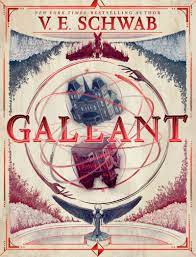
Early in February, I was graced with an email from Goodreads alerting me that I’d won an advanced reader’s copy of Gallant by Victoria Schwab in one of their hosted giveaways. I was ecstatic for two reasons, the first being because it’s the first in many, many entries that I’ve actually won something, and the second, it’s my first actual ARC (outside one of the many readily available ones on NetGalley for first-time reviewers).
Started Reading – February 21, 2022
Finished Reading – March 1, 2022
Rating: 3.75 stars (this was my initial rating but I feel as if it’s actually closer to a 4)
Leave it to me to not finish an ARC until the day of its release. There go my lovely whims in regards to writing a glorious review weeks in advance, preparing and building hype for its release. We’ll have to settle for this review timed perhaps a day or so Prior (pardon the pun) to a wave of fresh reviews from the public.
According to this summary blurb, “New York Times–bestselling author V. E. Schwab crafts a vivid and lush novel that grapples with the demons that are often locked behind closed doors. An eerie, stand-alone saga about life, death, and the young woman beckoned by both. Readers of Neil Gaiman, Holly Black, Melissa Albert, and Garth Nix will quickly lose themselves in this novel with crossover appeal for all ages.“
Home is a choice.
“Gallant”, Victoria Schwab
Olivia is a strong-willed girl, determined to make noise to prove her existence because of her inability to speak. After growing up as an orphan at the Merilance School for Independent Girls, her life takes a new turn when she receives a letter from an uncle she’s never met, inviting her home. When she arrives at the family estate known as Gallant, we see her curiosity and determination in full view as she takes in the oddness of the home she’s entered and tries to make sense of the unspoken.
I’m not sure if it specifies her age, but for the majority of my reading this book, I found it read closer to a middle-grade than a young adult. I think this was because I found Olivia a bit naive, but not to discredit her. Though her adamant resolve came off a bit young at times, she’s an admirable character who reads as resolute.
He [Olivia’s father] was ill. Her mother spoke of it, the way he seemed to wane as her belly waxed, some wasting sickness that stole him weeks before Olivia was born.
Gallant, page 14
Having lost her family so young, Olivia has craved a place to belong her entire life. All she knows of her parents is her mother’s battered journal that dissolves into strings of insanity. She never fit in among the girls at the school where she was raised, so when she gets a chance to meet and join the family she’s never known, she’s cautiously excited to see what that future holds. When she arrives at Gallant, though, she’s met with bewilderment from the keepers of the home.
But the bolt draws back, and the door swings open. Not all the way, just enough for a woman to look out. She is stout, with rough-hewn edges and wild brown curls, threaded with silver. She has the kind of face Olivia has always loved to draw–every emotion played out on skin, open, expressive. And right now every line and crease folds into a frown.
“What in God’s name…” She trails off at the sight of Olivia, then looks past her to the empty drive, and back again. “Who are you?”
Gallant, page 41
And not only bewilderment, but also disdain from her cousin, Matthew.
… Moments later a boy strides in, studying a pair of gardening gloves. He is older than Olivia by several years, nearly a man, tall and sapling thin, with tawny hair. […] He looks up at last and sees her standing by the fire.
“Who are you?” he demands, the softness melting from his voice.
Gallant, page 51
Along with this, Olivia has seen ghouls, decaying spirits, for years while at Merilance, and wondered if those beings lived at the school alone. However, she soon discovers that they seem tied more to her than where she grew up.
As Olivia crosses the house, the candle wavers, and so does her shadow. When she shifts the light from hand to hand, it leaps unsteadily around her, so it takes her a moment to realize she is not alone.
The ghoul stands halfway down the hall.
A woman–or at least, the pieces of her, hanging in the air like smoke. A curtain of dark hair. A narrow shoulder. A hand, drifting out as if to touch her.
Gallant, pages 65-66
Facing constant contempt from her cousin and increasingly numbered peculiarities, the story unfolds ever slowly, small pieces of information at first until it blooms into something deeper and darker than she had ever realized before.
Olivia catches Edgar’s eye. Is he sick?
He flashes Hannah a look and then says, “Matthew’s tired. Tired can be a kind of sick, if it lasts long enough.
Gallant, page 107-108
As her cousin’s health continues diminishing into fading complexions and terrorizing nightmares, Olivia also notes other strange things around the estate. A bizarre sculpture of two mirrored houses in a forsaken study, gray weeds, stripped entirely of their color popping up in the garden every day, a crumbling wall that stretches all of ten paces, and the iron passage nestled amongst it, unbudging. In all of this, she holds onto her mother’s diary, and the words inside them.
The jagged writing drops away, leaving only empty space, blank pages stretching to the very last page, where the letter waits.
Olivia Olivia Olivia
Her gaze drops to the bottom of the page.
You will be safe as long as you stay away from Gallant
Gallant, pages 63-64
What secrets does this house hold? And what will it take to uncover them? Olivia is determined to do whatever it takes to get to the bottom of her family’s elusive history, and learn where it is she comes from and where it is everyone else went.
Though this is my first read of Schwab’s (I am also currently reading The Invisible Life of Addie LaRue), I know she has proved her widely-noted richly descriptive writing further with this young adult modern-gothic. The pacing of this story intrigues me because while it’s a fairly easy read, the structure makes it something close to a slow build with its reluctance to divulge its secrets. It picks up exponentially in the final third, diving into and dwelling in the gothic themes it’s teased. This is a story of life, death, and all the strange things in-between, with family and the yearning to belong at its core.
Schwab’s prose is lovely, and I’d say the environment of this novel is what won me over above all. The few characters are nice, and the plot is gradual, but the depictions of what lingers in the shadows, the madness that threatens to wrap its fingers around the characters’ minds is what stands out. I mentioned earlier that this book came off more middle-grade to me, and the level of suspense ties into that. It’s nothing too overbearing, but it’s apparent and outfits this read nicely.
I’d recommend this book to fans of middle-grade and young adult fantasy, specifically those who favor paranormal fantasy with ghosts, ghouls, and other gothic elements.
Are you familiar with Victoria Schwab (aka V.E. Schwab), and/or her previous works? Did you enjoy them? Why or why not? Have you or do you plan on reading Gallant? I’d love to hear your thoughts, recommendations, or opinions down below!

 Little Bit of All That
[…] Review to come tomorrow (release day)! […]
LikeLike
Glad you liked this! As a huge fan of Schwab’s, I’d say that her strengths are really on her prose and her ability to create a chilling atmosphere (I called her prose in ADSOM a “cinematic writing”). Can’t wait to read this one. Great review!
LikeLiked by 1 person
Ooo, I like that description a lot, “cinematic writing” — I’m hoping to pick up ADSOM soon, once I finish The Invisible Life of Addie LaRue. It looks like I’m definitely a fan in the making haha. Thanks for reading!
LikeLike
[…] overarching impression of this novel–aside from Schwab’s decadent prose–was that it was. so. very. slow. This isn’t a fault, necessarily, but I’m a slow […]
LikeLike
[…] is the first ARC I’ve ever received, and I happened to have acquired it physically through a giveaway which was quite honestly a […]
LikeLike
[…] decadent, and I think it’s the strongest facet of the work I’ve read by her. Though Gallant has virtually no plot, I didn’t mind because of the gothic atmosphere and overall vibe of the […]
LikeLike
[…] adds the books to your “to-read” shelf) because I’d just won an ARC of Gallant by V.E. Schwab, and my interest was piqued. Anyway, upon writing this, I was planning on removing In My Dreams I […]
LikeLike