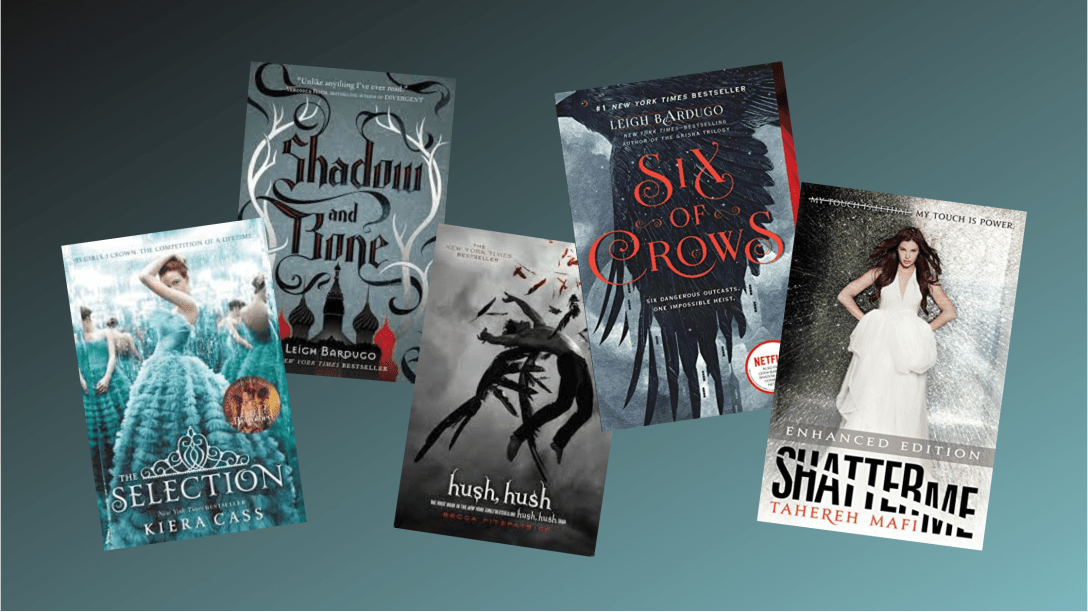
In the past year, I’ve noticed the strangest trend. Somehow, in some way, today’s most recommended books in the online reading community center around the likes of The Selection by Kiera Cass, Shatter Me by Tahereh Mafi, and Shadow and Bone by Leigh Bardugo. To quote immaculate songstress, Taylor Swift, I must say, “I think I’ve seen this film before…”
This rise in early 2010s young adult fiction struck me as incredibly odd. While these books had a ton of buzz surrounding them back in the day, I’ve seen them mostly dissolve into obscurity. Of course, this isn’t entirely true since we’ve seen the Shatter Me series in more recent years, and this whole genre of dated romance novels disguised as dystopia has popped back up. After a bit of time trying to deduce the cause of this spike, I’ve come up with a few contributors.
Booktok and Its Recommendations
Firstly, I find it crucial to bring up BookTok. I don’t personally have a TikTok account, so my experience with BookTok is exclusive to the occasional Youtube compilation. Despite this, even with my level of detachment, I can still see the effect this platform has on the online reading community. To pin the first factor on BookTok alone certainly doesn’t capture it in whole, because that’s merely a platform, not a precise catalyst.
So what caused its popularity on that social media venue? How have these books left the dusty shelves of old and wandered into the hands of a newer generation of readers? Is it brought on by older readers’ nostalgia or some other invisible factor?
Author’s Continuing Completed Series
To bring it back to one of the aforementioned series in this article, the first Shatter Me novel was published in late 2011. Unravel Me came out in early 2013, and Tahereh Mafi released the conclusion, Ignite Me, in early 2014. Four years later, despite already wrapping up the trilogy, Mafi announced an additional three books to the series and released Restore Me in early 2018. Subsequently, Defy Me was released in 2019, and Imagine Me in 2020.
In another example, the popular Legend trilogy by Marie Lu followed a near-identical publishing pattern to the first three Shatter Me books, with Legend coming out in late 2011, Prodigy in early 2013, and only differing with Champion coming out later that same year. It was in 2019, six years later, that she released an addition and new conclusion to the series with Rebel.
Even the founding fathers (or mothers?) of modern YA fiction–Twilight and The Hunger Games–have seen revivals. Twelve years after Breaking Dawn‘s publication, Stephenie Meyer released Midnight Sun, a retelling of Twilight (first published in 2005) in the opposing perspective. Suzanne Collins wrapped up The Hunger Games trilogy in 2010 but came back a decade later with the prequel, The Ballad of Songbirds and Snakes.
Considering the commonality of picking up finished series, I can see how books like Shatter Me are still relevant to this day–that conclusion was released in 2020 for goodness’ sake, and that’s when TikTok began reaching its peak. Its popularity on BookTok makes sense. Perhaps it’s fair to mention that I was out of the book scene for several years and hadn’t realized there were books beyond the original trilogy. Regardless, these elongations prove to be a contributing factor to their longevity, even ten years later.
Whether or not these continuations are just pandering cash-grabs is a topic for another time.
Cinematic and Television Adaptations’ Effect On Literature
Tied with the rise of young adult fiction was the increase in adaptations. In all honesty, I think the film and book industry somewhat complimented each other because of it. For example, The Hunger Games was first published in 2008 but it was following the 2012 film adaptation that the book then dominated best-sellers lists. The books within the trilogy inhabited six spots (including paperback, hardcover, movie tie-in, and box set editions) on the Neilsen Bookscan Top 20 list for that year.
And without the Twilight movie adaptations, I don’t think the young adult genre would look the way it does now. It set the standard. The final film in the saga was released in 2012 and was the fifth highest grossing movie of the year. The Hunger Games beat it out at #3.
After 2012 came the flood of adaptations. The following are some of the books adapted into 2013 film releases.
- The Spectacular Now by Tim Tharp
- Ruby Red (Precious Stones Trilogy, #1) by Kerstin Geir
- Beautiful Creatures (Caster Chronicles, #1) by Kami Garcia and Margaret Stohl
- The Host (The Host, #1) by Stephenie Meyer
- City of Bones (Mortal Instruments, #1) by Cassandra Clare
- The Book Thief by Markus Zusak
- Catching Fire (Hunger Games, #2) by Suzanne Collins
And then came 2014. We got some decent movies out of this before certain franchises fell off.
- Vampire Academy (Vampire Academy, #1) by Richelle Mead
- Divergent (Divergent, #1) by Veronica Roth
- The Fault in Our Stars by John Green
- The Giver (The Giver, #1) by Lois Lowry
- If I Stay (If I Stay, #1) by Gayle Forman
- The Maze Runner (Maze Runner, #1) by James Dashner
- Mockingjay (Hunger Games, #3) by Suzanne Collins
2015 and 2016 saw mostly waning success and average attempts.
- Insurgent (Divergent, #2) by Veronica Roth
- Paper Towns by John Green
- The Scorch Trials (Maze Runner, #2) by James Dashner
- Mockingjay (Hunger Games, #3) by Suzanne Collins
- The 5th Wave by Rick Yancey
- Allegiant (Divergent, #3) by Veronica Roth
- Miss Peregrine’s Home for Peculiar Children by Ransom Riggs
- Fallen by Lauren Kate
The Mortal Instruments by Cassandra Clare saw another adaptation after the 2013 film with Shadowhunters, a TV show premiering in 2016 and running three seasons. However, there were a few failed pilots/scripts as well with The Selection by Kiera Cass, Delirium by Lauren Oliver, and the film-turned-TV-turned-nothing adaptation Ascendant (the conclusion to the Divergent series).
There were a few more movies thereafter, Lauren Oliver’s Before I Fall, James Dashner’s The Death Cure (remember this? probably not), etc. Nothing particularly of consequence. By 2018, YA had transitioned into a new era and contemporary YA books like Simon vs. the Homo Sapiens Agenda by Becky Albertalli, To All The Boys I’ve Loved Before by Jenny Han, and The Hate U Give by Angie Thomas were getting attention over the dying paranormal romances and dystopians.
In early 2021, we saw a Netflix adaptation of the two young adult fantasy series Shadow and Bone and Six of Crows by Leigh Bardugo. After nearly a decade, Shadow and Bone finally got to live onscreen. Following the success of the show, the series came back into the reading community’s focus and joined Shatter Me in top recommendations. Because of this visual rendition of the beloved series, we saw the popularity of the source material spike all over again. (I dnf-ed Six of Crows in 2017 and honestly never would’ve given it another shot had it not been for the Netflix show–now it’s one of my favorite series.) It’s become apparent that film/television adaptations can play a huge role in the relevance of a book series. We saw that with The Hunger Games in 2012 and we’re seeing it again now with Shadow and Bone/Six of Crows.
Some adaptations of old YA series I’ve heard rumblings of include the following:
- a second season of Shadow and Bone by Leigh Bardugo on Netflix
- a Netflix movie for The Selection by Kiera Cass (so that’s why it’s getting attention again…if you’ve read this series and haven’t heard about the original failed pilot, I’d recommend this video for a laugh)
- a film on Paramount+ for Hush, Hush by Becca Fitzpatrick
- a show on Peacock for Vampire Academy by Richelle Mead
- a TV show for Legend by Marie Lu
- a show on Peacock for Red Queen by Victoria Aveyard
I’m surprised there hasn’t been more development on an adaptation for Shatter Me considering all the hype around the book series lately. Not that I know anything, but Production Companies, you should probably keep that in mind…
Maybe New Readers Are Just Late to the Game
When I tried to explain this peculiar ressurection to my brother, I used his language and at first described it as someone being like, “Hey, let me recommend this super cool movie The Avengers!” But I realized that’s not quite right. Everyone knows The Avengers, and Marvel has been massively popular ever since its release in 2012 (or even back to when the first Iron Man came out in 2008). It’s still clear in our minds and memory. This revival is more like the X-Men movies — they were definitely something in their time, but who even thinks about them anymore? We’ve pretty much progressed past them as a society, haven’t we? Well, perhaps not.
As long as a piece of media exists, it’s always going to be new to someone, and somebody’s going to think they’ve found the coolest, most niche thing ever. Even if it was something absurdly popular, it wasn’t known to them, so it’s new and cool and fresh. That’s how I see this renewed love for series I’d completely forgotten about. And these pieces of media don’t even have to be good!
Regardless of the quality in this wave of books, they were popular for a reason. Though the publishing industry of 2010s YA fiction was a breeding ground for “not-like-most-girls” female leads, chosen ones, hackneyed love triangles, not-pretty-but-not-ugly protagonists, and 15-year-olds leading rebellions, it had its place. Was it flawed? Absolutely. But it was still significant to the culture of young adult fiction.
And if it’s not good, who cares? I remember being thirteen years old, devouring every book by Kiera Cass, and coming across her YouTube channel from when she was publishing The Selection series. I recall her saying some books are like that of fine dining, but hers were mac n’ cheese — and that spoke to little baby me. The fact of the matter is, things do not have to be “good” to be enjoyed. There’s a definite place for both.
In saying that, I’m not necessarily calling Shatter Me or The Selection bad. There’s going to be haters for everything, but there’s likely always going to be fans too. Hence this resurgence of 2010s young adult fiction. These books had something that drew us to them in the first place, so why wouldn’t they still have something for those previously unaware? That’s a perfectly fair deduction to make.
So, What Do We Do With This Resurgence?
In trying to determine the where and why of this whole situation, I’ve found myself looking back on those old favorites and wanting to revisit them myself. In fact, I’ve already started without even intending to. Last year I picked up Six of Crows and Crooked Kingdom (and Shadow and Bone this year!) as a natural step following my enjoyment of the Netflix adaptation, and I found a place to enjoy The Raven Boys by Maggie Stiefvater for free, so I took advantage of it. I’d never even heard of The Raven Cycle until last year — in all of this, it turns out I’m just the same as everyone recommending Shatter Me and The Selection like it’s a brand new thing!
In conclusion, it makes sense for things to come in and out of style. A lot of these stories had their popularity, sat in hibernation for a while, and are ready to be loved again whether by being translated into film/television or landing in the hands of new readers. Whatever the case, it’s expected for these things to ebb and flow.
This was an interesting topic for me, because I love looking into where things come from and why. Seeing the origin of things and what inspires other works is so profoundly intriguing to me that I had to spend a bit of time on this thinkpiece. In fact, I’d like to look further into this and explore the trends of young adult fiction as a whole, from where it first garnered massive commercial success (arguably with J.K. Rowling’s Harry Potter, though the works of C.S. Lewis and Madeleine L’Engle are also worth mentioning), how Twilight’s paranormal romance influences and Hunger Games dystopian elements contributed to it, how we’ve gotten to where we are today, and how “young adult” is often perceived as a genre unto itself (if you’re at all interested in this last point and the history of this facet of fiction, I’d recommend this video and its second part — I found it a very interesting discussion on the matter).
What are your thoughts on this revival of older YA staples? Are these reads new to you or old news? Are there any adaptations you love, hate, look forward to, or dread? Do you have any other thoughts or insights on this resurgence and other things keeping these books relevant? Share your thoughts below!

 Little Bit of All That
Loved this piece! It was a very insightful analysis on the many factors behind this trend—and personally, I think the pandemic really amplified it when people who were reading these books in 2010 started “fleeing” back into a place of nostalgia and safety in 2020. I’d love to read more on your thoughts about the YA genre!
LikeLiked by 1 person
I’m so glad you enjoyed it! That’s a really good point about the pandemic being a big contributor to this returning to the past, that hadn’t even crossed my mind. Thank you for sharing that insight, I completely agree, and thank you so much for reading!
LikeLiked by 1 person
[…] On 2010s YA Fiction […]
LikeLike
Such great insight!! I’ve never really thought about this topic before, even though it’s so true!! I’m so glad you picked up Six of Crows again! I love the Grishaverse!!!
LikeLiked by 1 person
Thank you so much! I really enjoyed composing this post — I’ve been meaning to write a few more like it for a while. I’m also so glad I picked up Six of Crows again! It’s an all-time favorite now. 🙂
LikeLike