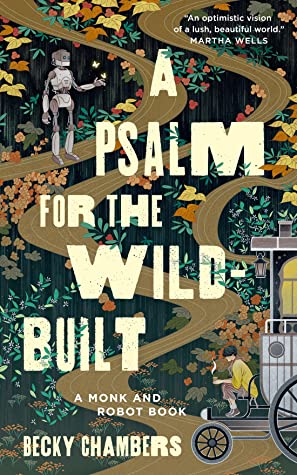
In short, this novella is just a treat. The dedication reads, “for anyone who needs a break”, and I think that’s a perfectly fitting demographic to pitch to. It’s a lovely one-sitting sort of read (I consumed most of this in just one day, which is pretty unheard of for me), and a gentle reprieve from the complexities and overrunning nature of the world.
Started Reading – April 2, 2022
Finished Reading – April 4, 2022
Rating: 4 stars.
The first chapter failed to hold my interest, which worried me, but upon pushing through it, I found myself pleased. After switching vocations and still facing discontentment, Dex, a tea monk unsatisfied with their life, takes it upon themself to venture into the wild world, untouched by civilization for centuries, in search of, small as it may seem, the sound of crickets at night. In their research, they trace the possible existence of the otherwise extinct insect to an abandoned monastery. Upon setting out on this journey, they finally feel renewed hope and enjoyment.
Nobody in the world knows where I am right now, they thought, and the notion of that filled them with bubbling excitement. They had canceled their life, bailed out on a whim. […] Dex didn’t know who they were, in that moment. Perhaps that was why they were smiling.
A Psalm for the Wild-Built, page 47-48
In the wake of this new life’s buzz, Dex is faced with a new development: the sudden presence of a seven-foot robot, an anomaly they thought belonged only to children’s stories. However, this being, introducing itself as “Mosscap”, is, in fact, quite real. In conversation, Mosscap reveals the purpose of its own journey.
Mosscap stretched out its arms, bent them deliberately, and set them down with a chuckle. “Sorry, there’s just so much here to experience, I keep getting distracted.”
“I wouldn’t have guessed that robots got distracted.”
“Why not?”
“Well, can’t you…I don’t know, run programs in the background, or something?”
Mosscap’s eyes adjusted their focus. “You understand how resource-heavy consciousness is, yes? No, I can’t do that any more than you can. But we’re getting off track. To the point–I was sent here to answer the following question: What do humans need?”
A Psalm for the Wild-Built, page 58-59
From there, thoughtful, inquiring interactions slowly blossom the two into friends. A contrasting but complementary pair, Dex’s and Mosscap’s respective disillusionment and wide-eyed intrigue weave together to reveal fascinating points about identity and purpose.
“You’re so…flexible. Fluid. […] I figured you’d be all numbers and logic. Structured. Strict, y’know?”
Mosscap looked amused. “What a curious notion.”
“Is it? Like you said, you’re a machine.”
“And?”
“And machines only work because of numbers and logic.”
“That’s how we function, not how we perceive.”
A Psalm for the Wild-Built, page 74
In their newly shared journey and exchanges, they gain insight into one another, and it’s just lovely to witness. If nothing else, this book is a breath of fresh air.
At times, I found myself wondering if, despite their differing temperaments, the distinction between human and robot was strong enough. After all, I think we view consciousness as synonymous with humanity (in that animals do not have that level of cognitive development), but it’s something apparently shared with this story’s robots. Upon further thought, though, I can see the characters’ variation in perspective on the book’s largest theme, the pursuit of greater purpose and its significance (or perhaps even insignificance). I think the utilization of these opposing figures (human and robot) is used to illustrate this idea, and in their ability to do that job, I found the separation evident enough in my eyes.
The explorative discussion on greater purpose is an utterly fascinating one. Something else that drew me in was that underlying question of what defines humanity, and what makes it different from what other creatures have vested in themselves–if there is any difference at all. I don’t (and can’t, really) fault the book for not running with this train of thought, because this piece is enough food for thought on its own, and it’s only through grazing on it that the seed of that idea planted itself into my head. However, I do think it’d be an interesting thing to see in a book like this, where these interactions between a human and a non-human are at the forefront.
I quite enjoyed this book, and am glad to have started off my reading month on a high note. Science fiction hasn’t ever piqued my interest much (though I thought it did as a young reader since I referred to all my beloved dystopians as such, even if there wasn’t much science to them at all), and I think it’s likely the contemplative nature of the novel that caused me to enjoy this so much, but whatever the case, I’m looking forward to picking up the second (and final, I believe) book in this series coming out this summer.
Have you read or plan on reading A Psalm for the Wild-Built? Did you like it? Why, or why not? Did it get you to think about much, or were your more focused on the comforting escapism it provides (because, though I didn’t mention much about it, it houses much of it)? I’d love to hear your thoughts below!

 Little Bit of All That
[…] A Psalm for the Wild-Built (Monk & Robot, #1) by Becky Chambers […]
LikeLike
[…] changing things up this year by picking up and enjoying more science fiction than I have in times past, I really thought I’d love this book, especially after reading the […]
LikeLike
[…] This novella is a nice slice of escapism into a purer world of cyberpunk persuasion. It’s contemplative and kind and such a lovely getaway from all the less-than-ideal things we encounter in the real life day-to-day world. This story takes its time perusing through ideas and light philosophizing via the main characters first nearly at odds before securing themselves into a purer, more symbiotic dynamic. Above all, it’s a treat. […]
LikeLike
[…] 1. A Psalm for the Wild-Built by Becky Chambers (Monk & Robot, #1) […]
LikeLike
[…] I’m not much of a science fiction reader (my forays with the genre are mostly limited to the cozy solarpunk Monk & Robot novellas and various YA dystopians) but it was fairly digestible for me. However, while I didn’t find […]
LikeLike