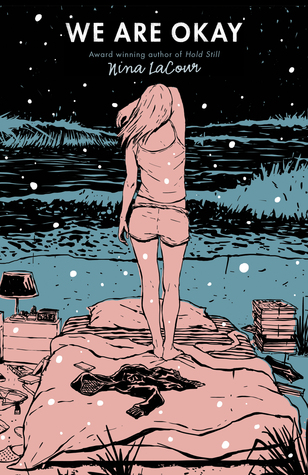
Upon looking at the oldest books on my Goodreads TBR, I found that this novel was in those first few added, and now, after a long five years, I’ve finally picked it up. And while I enjoyed reading it this time around, I’m not sure it was quite the time for me to read it. Allow me to explain.
Started Reading – April 18, 2022
Finished Reading – April 21, 2022
Rating: 3.5 stars.
Marin, a college freshman, finds herself alone on an empty New York campus when her fellow students disperse for winter break. Having left behind the life she knew across the country only months ago, she stays put. Instead of going home to a place she no longer knows, her best friend, Mabel, comes to town, seeking reconnection after Marin’s sudden disappearance. This story is told in split timelines, depicting both the days spent with Mabel over winter break, as well as the previous summer where everything changed forever.
This is a book of loss, grief, loneliness, and connection. It’s a subtle, intimate work, and quite a lovely read. When I first picked this up, I figured I’d lump it into my favorite genre, “fake deep (affectionate)”, but this novel is less self-indulgent and more modest in its rawness and overall tone–and in being so, makes it respectable and understatedly earnest.
The entire time I spent reading this, all I could think about was how much this seemed like a book right up my alley. However, I think I harped on this in my mind a bit too much, because it somehow managed to distract me from my time spent with it, and I didn’t find it quite as evocative as I thought it may end up being. However, this is not its fault, and this is where I’ll expound on my allusion to a reread.
In my review of The Midnight Library by Matt Haig, I mentioned how strongly I believe in the subjectivity of art, specifically literature. When I pick up a book, it’s often the ones that rip my heart out that wind up my favorites, usually regardless of their objective quality. Tying into this, the books of that sort that I find myself favoring are those that I picked up and devoured in particularly volatile times in my life, and I think that’s a general happening for most. Whatever art we consume at a life-changing period in time is likely to stick with us.
When I picked up We Are Okay, and in the time spent reading it, I don’t believe I was in the best place to consume it–which is to say, shockingly, a fairly good and stable time in a life with excessively melancholic undertones. Yes, I’m saying I wasn’t sad enough for this book. Is this a silly thing to claim? Absolutely, but silliness never inherently contradicts truth.
Regardless of my personal attachment to and lingering impression of the story, this is a well-written book, with the potential to reach deep inside its reader and tug at something in them. It focuses on its characters over its plot (a particular preference of mine), and the way it navigates Marin’s struggles is very tangible and authentic in a way that keeps it from falling victim to being pretentious or preachy. I used the word “intimate” earlier, and I think that’s very fitting for this story.
I plan on reading this again sometime in the future because I know that it packs a punch, and I’m more apologetic that I’m a lacking punching bag rather than at all disappointed with the story presented.
Have you read, or do you plan on reading We Are Okay by Nina LaCour? Did you like it? Why, or why not? I’d love to hear your thoughts below!

 Little Bit of All That
[…] We Are Okay by Nina LaCour […]
LikeLike
[…] This story of grief and working out the unsureness of young love is a bit paradoxical in that it is at once tender and modest while also being evocative and arresting. It presents itself plainly, laying out the facts of the scenes, and, in turn, accentuates all the subtleties and underlying aches, pains, and longings of the characters within these pages. I hope to pick this story up again in a few years because I expect it to hit even harder at a time when I really need it. Even at a time when I felt it was a bit misfitting, it still pierced through then. […]
LikeLike