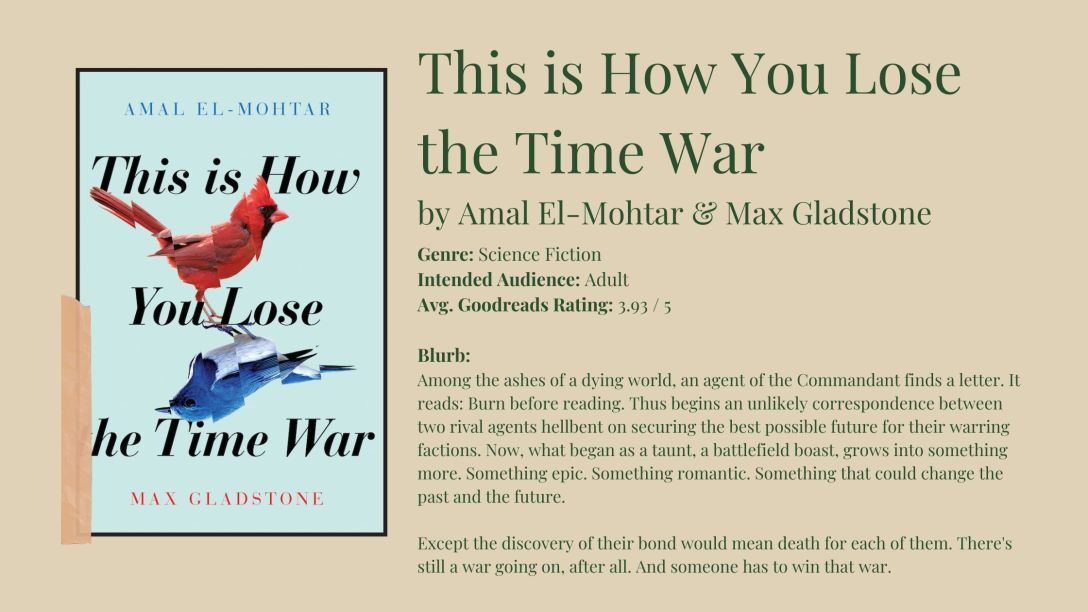
Hello, everyone! Happy March. 🙂 I’m elated to see warmer days lately where I’m at. Spring is slowly springing! I’ve been waking every morning to birds chirping and singing (a bit like the ones on this cover, actually — especially since cardinals are actually Virginia’s state bird). How is March treating you so far?
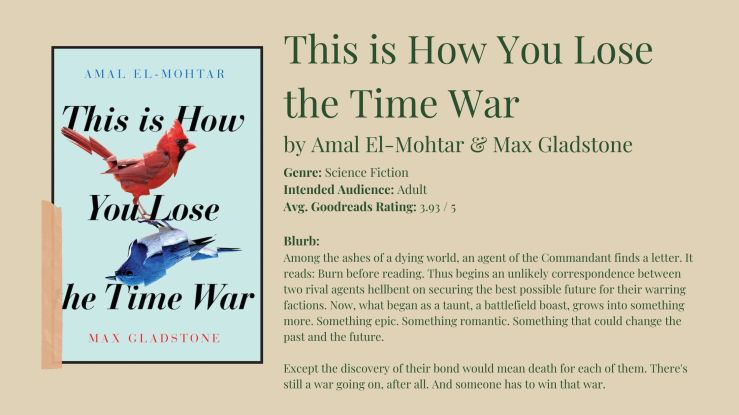
Whenever I’ve heard talk of This is How You Lose the Time War over the last few years, it’s never been without mention of this book’s lyrical prose, and I think that makes perfect sense as I’d say it’s this book’s most prominent trait. I think it’s certainly one of or perhaps the main strength of this novella. But it also may be just as much so it’s greatest weakness.
Set in a sci-fi reality, there’s relatively identifiable worldbuilding in terms of politics and time continuum function which I enjoyed. I’m not much of a science fiction reader (my forays with the genre are mostly limited to the cozy solarpunk Monk & Robot novellas and various YA dystopians) but it was fairly digestible for me. However, while I didn’t find the information itself overly complex, I have to admit that it was somewhat difficult to decipher the details due to the story’s vague, flowery prose. (This may not be the case for everyone but it was significant to my reading experience).
That being said, I can understand why this genre-bendy story would focus more on the language and characters than the functions of the world. Because while this novella has time travel and the war springing from it laced throughout, the core of this story is the romance itself.
I’ve not actually read too many “rivals-to-lovers” or “enemies-to-lovers” stories in my time, so I can’t judge too much on how it was executed in this book. I thought the vitriol conflict and magnetic push and pull of opponents was quite engaging in the beginning. From my limited understanding of the trope, though, I believe a hallmark of enemies- or rivals-to-lovers is the slow burn, festering nature of the relationship. Because of that, I don’t know that this relationship could be quantified as such since the romance blooms so early on in the story. I don’t know that this book is always referred to as having this trope but with the way this story begins, I thought it would’ve been more effective had the personal tensions and stakes of the relationship been stretched a bit further. There was definitely the external stakes of keeping it secret from their respective agencies but I would’ve liked to maybe see more inner conflict as well.
This may be just because I’m not usually a romance reader but I had a little bit of a hard time seeing where/how the shift into lovers began. It felt a little hard to believe that progression from just the words on the page — though the correspondence between the characters is thoroughly enrapturing.
I’m a total sucker for interesting narrative takes (like the collective narrator in Jeffrey Eugenides’ The Virgin Suicides, the unreliable narrations of Gillian Flynn’s Gone Girl, or any of the other epistolary novels I’ve read) so I really enjoyed the love letters interwoven throughout this story. Oscillating between these intimate notes and the somewhat bird’s-eye (pardon the pun, if you could call it that) story narration, I enjoyed this facet even more than the airy, elusive prose itself.
Ultimately, I didn’t actively dislike anything about this novella. There were things that weren’t done totally to my taste but that has more to do with personal preference and shouldn’t reflect poorly on the book itself. This pretty, somewhat peculiar love story is certainly a pleasant read, and I’m glad that I picked it up!
If you enjoy books with an emphasis on prose and character relationships, especially with a speculative world backdropping it, I’d definitely recommend Amal El-Mohtar and Max Gladstone’s This is How You Lose the Time War! If you’re looking for a story focusing more on worldbuilding and plot, this may not be the one for you.
Have you read This is How You Lose the Time War? Did you enjoy it? Why, or why not? What are your thoughts on prose and its veering into purple territory? What are your thoughts on the enemies- and/or rivals-to-lovers trope? Do you think Red and Blue’s relationship could be described as such? I’d love to hear your thoughts below!
- Winter ’26 Reading & Writing Wrap-Up
- My 2025 Year in Books Ranked
- Top 10 Books on My Winter ’25-’26 TBR | TTT
- Fall ’25 Life Updates: Moving, Nanowrimo, & Hardly Reading
- Annual Library Book Sale Haul: 2025 Edition
[DISCLAIMER: Photos in this post may be paired with Amazon affiliate links, meaning I’d earn a small commission from qualifying purchases. Thank you for your support!]

 Little Bit of All That
Great review. I completely agree, this book is basically all just vibes and whether you love it or not is likely going to be down to how much you just let go and feel those vibes – because it is totally vague on a lot of things. I happened to love it but I also didn’t really know what was happening 😂
LikeLiked by 1 person
Thank you! You’re so right, it’s such a quintessential “no plot, just vibes” book — I love that there’s space for those type of stories to exist because they can be so nice at the right time. 🙂
LikeLiked by 1 person
Great review! I also like stories with unique narration, I’ll have to check this one out.
LikeLiked by 1 person
Thank you! If you get to it, I hope you enjoy. 🙂
LikeLiked by 1 person